Permanent investigation / Technology, infrastructure and public value
Data Centers: Infrastructure, Power, Water, and Public Value
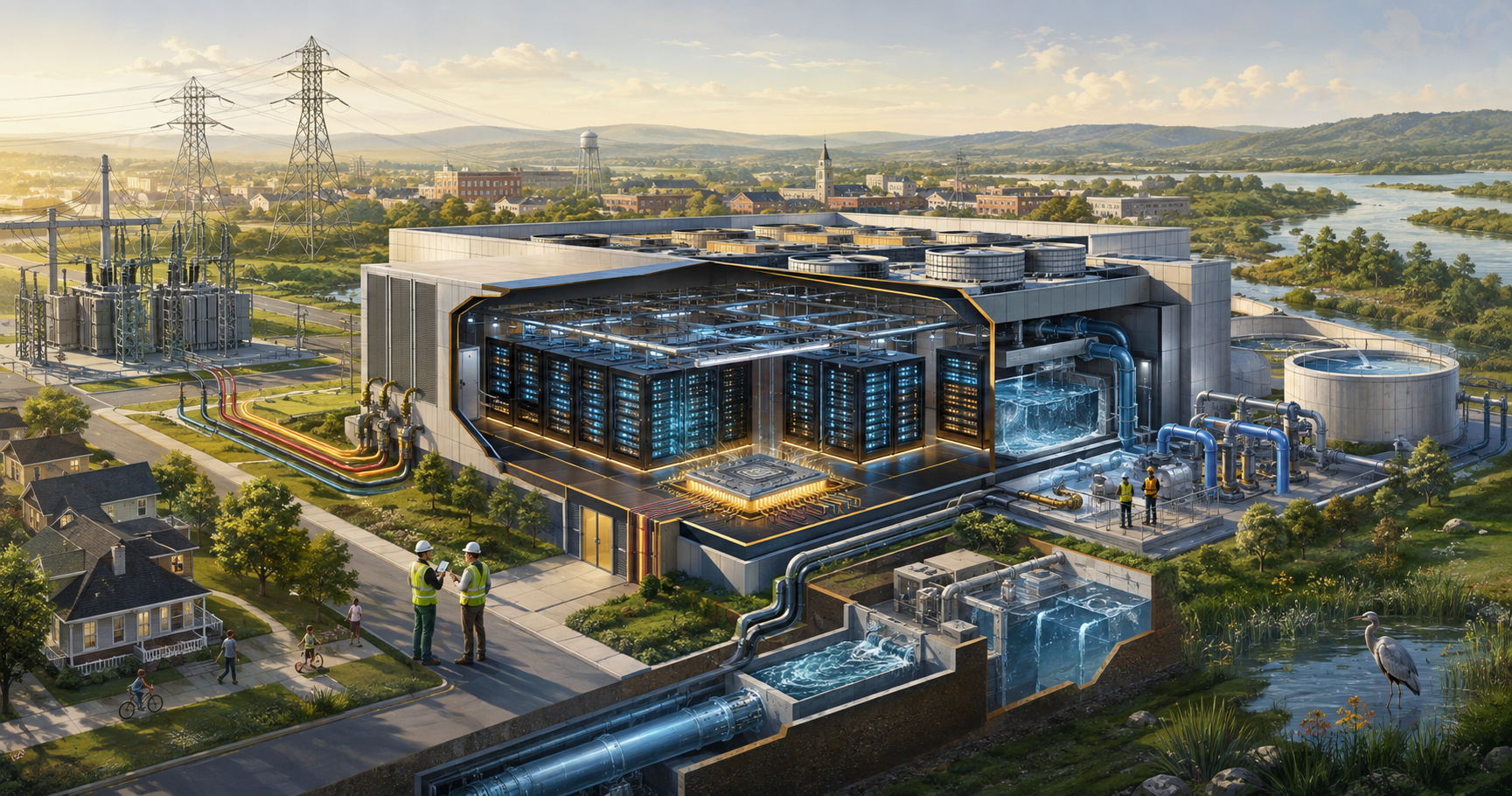
Project, Research, Analysis, Editorial by Patrick Russell; assisted by ChatGPT (OpenAI).
A data center is a factory that converts electricity, water, land, chips, capital and expertise into computation. The public question is not simply whether data centers are needed, but which facilities, in which places, for which uses, on whose terms.
Established August 29, 2026 · · Project comparison integrated October 3, 2026 · Semiconductor supply-chain update October 14, 2026 · Other sections retain their cited evidence dates
The question this investigation answers
Which data centers, in which locations and on whose contractual terms, deliver durable public value after their complete costs?
Distinct finding and connected evidence
- What this investigation adds
- A project and system assessment of demand, grid capacity, ratepayer exposure, water, land, jobs, subsidies, security and long-term liabilities.
- Evidence assessed here
- Project permits and contracts, utility tariffs, actual investment, connected load, resource use and operating employment, with announcements separated from delivery.
- Next evidence test
- Reconcile each project’s stage and power requirement, identify who pays for expansion and test whether promised jobs and protections are delivered.
- Supporting project profiles
Facility-level records belong to this investigation; its Projects section contains the comparison and findings using a common public-value test. Pledged investment and transferred ownership are not additional completed capacity.
- Nuclear
Owns generation safety and economics; this investigation tests whether a supply arrangement meets a particular computing load without shifting costs.
- Political Narrative Watch
Checks specific claims; this investigation establishes the technical and contractual evidence behind electricity, water and community effects.
Executive assessment
Necessary infrastructure does not make every proposed project necessary
Digital services are foundational infrastructure, and AI is creating a genuine new class of high-density demand. But the current buildout also contains forecast error, queue inflation, subsidy competition and a race to secure scarce power before every proposed workload exists.
Demand is real, but the range is wide. Global electricity use could nearly double by 2030 in the IEA base case. Financing, chip supply, construction, grid delays and efficiency can materially change the result.
Location determines impact. The same facility can be relatively benign on a clean, uncongested, water-secure grid and damaging in a drought-prone, transmission-constrained or fossil-dependent region.
Efficiency is not sufficiency. Better chips and cooling lower resource use per calculation, but cheaper computing can increase total use. Absolute power, water and emissions still matter.
Benefits and burdens are distributed differently. Global users and shareholders may receive the service while one locality carries the noise, water use, grid expansion and fiscal risk.
Contracts decide who pays. Rate design, subsidy terms, water rights, decommissioning security and enforceable performance standards are as consequential as the engineering.
Current scale
The buildout in four numbers
Electricity demand and investment are rising rapidly, although forecasts remain uncertain. These benchmarks show why data-center power, water, infrastructure and public-cost decisions now matter.
IEA estimate for data-center electricity consumption.
IEA base-case projection—nearly double 2025, but sensitive to finance and bottlenecks.
DOE/LBNL estimate; the 2028 range is 6.7%–12%.
IEA estimate—more than the $540 billion invested in global oil supply that year.
What is being built—and why
One label covers very different facilities
Enterprise
Owned or leased by one organization for internal systems, regulated data or mission-critical operations.
Colocation
Shared buildings where many customers rent secure space, power and network connections.
Hyperscale cloud
Large standardized campuses serving elastic storage, software, streaming and general computing across regions.
AI training
Dense accelerator clusters run long, power-intensive calculations to create models; high-speed networking is essential.
AI inference
Facilities operate trained models for real users. Demand may be geographically distributed and latency-sensitive.
Edge and sovereign
Smaller regional or nationally controlled capacity reduces latency, supports resilience and meets jurisdictional rules.
Analytical rule: A facility's public value depends on the workload. A hospital record system, a scientific model, targeted advertising, mass surveillance and speculative token generation are not socially interchangeable simply because all consume megawatts.
History
From protected computer rooms to industrial-scale computation
Mainframe rooms
Centralized government, university and corporate computers required controlled rooms, specialized operators, cooling and reliable power.
Enterprise computing
Banks, airlines, manufacturers and governments built larger machine rooms as databases and transaction systems became essential.
Internet and colocation
Commercial internet traffic, web hosting and telecom interconnection created carrier hotels and shared colocation facilities.
Cloud hyperscale
Virtualization and services such as Amazon EC2 turned computing into an elastic, metered utility delivered from very large campuses.
Mobile, streaming and edge
Always-on apps, video, social platforms and low-latency services expanded both hyperscale campuses and smaller regional sites.
AI factories
Accelerators, high-speed networking and dense liquid-cooled racks concentrate unprecedented power into facilities designed to train and serve AI models.
Facilities grew because computing moved from rare institutional machines to universal network services. Standardization, virtualization and cloud software raised utilization and pooled demand. AI has changed the physical design again: NVIDIA documents a current AI rack at up to 142 kW, while ASHRAE describes 120 kW to several hundred kilowatts per rack and anticipates megawatt-scale systems.
Technology and innovation
More useful work per resource—not just more machines
Compute
CPUs remain central for general workloads; GPUs and custom accelerators perform highly parallel AI calculations. The useful output is computation—training, inference, storage, transactions and communications—not the building itself.
Power train
Substations, switchgear, transformers, uninterruptible power supplies, batteries and generators deliver conditioned, redundant electricity. New designs use higher voltages, modular power blocks and longer-duration storage.
Cooling
Air cooling persists, while direct-to-chip liquid cooling, rear-door heat exchangers and immersion systems manage dense racks. Closed-loop and dry-cooling designs can sharply reduce water use, often with energy or capital tradeoffs.
Network and software
Fiber, switches, workload schedulers, virtualization and observability pool machines and move work across time and place. Better utilization can produce more useful computing per server and per megawatt.
Efficiency metrics
PUE measures facility overhead, not whether the computation is valuable, carbon-free or water-efficient. It should be paired with carbon, water, utilization, reliability and useful-work measures.
Emerging supply
Advanced geothermal, nuclear uprates and new reactors, grid-enhancing technologies, fuel cells and heat reuse may improve supply. Each must be evaluated for cost, timing, emissions, safety and who bears risk.
U.S. electricity infrastructure / September 30, 2026
The power bottleneck: emergency operations, investment and who pays
Reliable electricity connects America’s Ai ambitions to operating facilities, skilled jobs and useful services. September developments show why new generation, transmission capacity and enforceable customer protections must advance together.
September 30: a Korean-backed Texas power project moves forward
President’s stated position: President Trump announced up to $200 billion in Korean-backed U.S. energy investment: a $22 billion, 6.4-gigawatt gas-fired project in Encinal, Texas; eight proposed large nuclear reactors; and work toward the Alaska LNG project. He said the added power would support advanced manufacturing, semiconductors and other industries of the future.
Established facts: Reuters reports that South Korea selected the Texas project under the bilateral strategic-investment program and that it is intended to supply energy-intensive facilities including data centers and semiconductor plants. South Korean officials separately say only the Texas project is finalized; the nuclear and Alaska proposals remain under discussion. Announced value and capacity are not operating generation.
Claims and disputed matters: The administration presents the package as $200 billion of new U.S. investment and transformative capacity. Commercial viability, financing, final contracts, permitting, construction schedules, fuel and grid connections—and whether the full headline amount is ultimately deployed—remain material tests. The President described a $50 billion Alaska project, while Reuters reported roughly $54 billion.
Inference: A 6-plus-gigawatt plant built substantially for data centers and chip fabs would be a major supply-side response to AI-era load growth. It could reduce connection constraints, but it would also concentrate gas demand, emissions, water use and financial risk unless tariffs, contracts and permits allocate those costs to the large-load beneficiaries.
What remains unproved: No verified record reviewed for this update establishes completed financing, final offtake agreements, permits, construction commencement, an in-service date, delivered megawatts, customer tariffs, ratepayer protections, water requirements, emissions controls or a binding allocation between data centers and other users.
President Trump’s statement · Reuters verification and project context · Yonhap on Seoul’s project-status distinction
September 17–18: a temporary reliability emergency
DOE authorized PJM to dispatch specified resources and use backup generation as a last resort during forecast heat and planned transmission outages. The order ran September 17–18 and has expired. It demonstrates an operational reliability concern; it does not establish that data centers caused that event or that nationwide blackouts are inevitable.
September 24: expand the grid already in place
The Trump Administration’s DOE selected 31 SPARK grid projects across 26 states, with $1.9 billion in federal support and $3.35 billion in recipient funding. DOE anticipates rebuilding or replacing conductors on more than 1,500 miles of lines and deploying advanced technologies across nearly 21,000 miles, making more than 23 GW of additional grid capacity available.
These are announced investments and projected benefits. Additional transmission capability moves electricity; it is not 23 GW of newly built power generation. Completion dates, delivered capacity and actual customer savings remain the measures of success.
September legislative debate: growth without household cost transfers
The House passed the Ratepayer Protection Act on September 16 by 417–3. It would require state regulators to consider standards assigning incremental infrastructure costs to large electricity users; consideration does not guarantee adoption. Senator Jon Husted sought expedited Senate passage on September 17. Senator Martin Heinrich objected, arguing that mandatory protections were needed, and offered his GRID Savings Act. Senator Bernie Moreno objected to that alternative.
September 30 reporting describes renewed Senate consideration of the House-passed bill. This update does not establish enactment or a completed September 30 vote. Both proposals must be distinguished from existing tariffs and the White House’s voluntary pledge.
Husted’s legislative record · Heinrich’s competing proposal · September 30 Senate reporting
Assessment: Faster grid improvements can support national Ai leadership and industrial growth while relieving congestion. Public benefit depends on delivery and cost allocation: households should receive documented reliability and affordability gains, and large users should cover the incremental costs attributable to serving them.
What to track: Project commissioning and usable capacity; new dependable generation and connection times; emergency operating orders; adopted large-load tariffs, collateral and exit protections; and household bills compared with a documented baseline. An emergency order is a temporary response, an award is an investment commitment, and a bill is a proposal—none alone proves a completed solution.
Nuclear fuel, AI power demand and America’s energy supply
Focused evidence review October 10, 2026 · Original announcement and measurement dates retained
Status: Fuel-supply investment documented; delivered capacity and consumer savings remain to be demonstrated
America’s computing and manufacturing ambitions need dependable electricity. Scott Nolan’s discussion with Joe Lonsdale identifies an important link in that challenge: new nuclear reactors need a reliable fuel supply before they can deliver power. Public records support General Matter’s role in expanding domestic enrichment. The next question is whether financing, licensing and construction become qualified fuel, operating reactors and affordable electricity on the schedules that data centers require.
Related Strategic Directive: Global AI/SI Leadership — Data Centers · America’s Energy Revival — resources and fuel supply
General Matter: what the public record establishes
DOE announced a lease for a 100-acre parcel at the former Paducah Gaseous Diffusion Plant on August 5, 2025, with enrichment operations planned by the end of the decade. On January 5, 2026, DOE awarded General Matter a $900 million HALEU enrichment task order, alongside separate $900 million awards to American Centrifuge Operating and Orano Federal Services. DOE says payments follow milestones. The award is neither proof of full payment nor evidence that the proposed plant is operating.
EXIM’s March 17 announcement describes letters of interest supporting up to $4.2 billion in potential financing for General Matter’s fuel sales to Japanese and South Korean operators. Potential financing is distinct from a final loan, disbursement or completed export. These amounts should not be added into a claimed total already spent on construction.
Nolan describes an end-of-decade operating target and coordinated work on technology, manufacturing, construction and licensing. This review does not establish a final General Matter operating license or a guaranteed twelve-month review. A timetable announced for another applicant does not decide this project’s outcome. Track application acceptance, regulatory decisions, qualified output and actual deliveries separately.
Domestic enrichment exists; scaling and supply security are the issues
The interview’s broad suggestion that America has no enrichment at scale needs correction. DOE identifies URENCO USA in New Mexico and Centrus in Ohio as licensed production facilities. EIA reports that U.S.-origin enrichment accounted for 23% of the services purchased by civilian reactor operators in 2025; 77% was foreign-origin, including 26% from Russia. Those are enrichment-service shares, not shares of mined uranium, electricity or HALEU supply.
Existing domestic production and imported supply can coexist with a serious advanced-fuel bottleneck. Plant location, company ownership, technology origin and product qualification are different questions. General Matter’s contribution should be measured as additional reliable capacity and diversification, without erasing existing producers.
Fuel definitions and safety claims need precision
Natural uranium contains about 0.7% uranium-235; the transcript’s “711%” is a transcription error. Conventional reactor fuel commonly uses 3–5%. HALEU means greater than 5% and less than 20%, rather than only 10–20%. Fuel requirements depend on reactor design; small reactors do not all require the same enrichment.
DOE describes TRISO particles as a fuel kernel surrounded by carbon and silicon-carbide layers that retain fission products. That supports fuel robustness, not a blanket guarantee of accident-free reactors or the interview’s explanation that the coating automatically absorbs neutrons when hot. Safety judgments require the specific reactor design, tested conditions and regulatory record. DOE’s February 25, 2026 report confirms TRISO-X’s fabrication license while describing construction and irradiation testing still underway.
The pellet comparison also needs correction: DOE’s educational example equates one conventional pellet to roughly three barrels of oil, not more than one hundred. Fuel density is valuable, but it does not establish plant construction cost or a customer’s electricity price.
From a fuel factory to affordable power for AI
The interview mixes grid capacity with annual generation. Gigawatts measure capacity; terawatt-hours measure energy generated or consumed over time. Its “three times” and “a Texas every year” comparisons need a common year, definition and data series before being treated as verified U.S.–China benchmarks.
Nolan’s ambition for electricity below three cents per kilowatt-hour is a cost target. An older plant’s production cost cannot be compared directly with a present household tariff, which also pays for networks and other services. Test new-project construction, financing, fuel, operations, waste obligations and connection costs, then examine the actual contract and ratepayer allocation. Factory production may reduce costs with repeat orders; savings require evidence from delivered projects.
Fuel is one dependency among several. A data center still needs timely generation, grid connections, dependable service and a contract that assigns costs clearly. Restarts, uprates, large reactors, modular reactors and other power sources must be compared against the facility’s real demand schedule. This interview does not establish that every hyperscaler will rely on nuclear power or that a new enrichment plant solves near-term shortages.
SpaceX’s execution lesson—and its contracting limit
Nolan’s account of SpaceX emphasizes reducing cost and shortening the critical path. That is useful management testimony, rather than an audited comparison of every SpaceX and Boeing program. His example of receiving a constant percentage above costs also oversimplifies federal contracts: FAR 16.102 prohibits cost-plus-percentage-of-cost contracting, and FAR 16.306 says a fixed fee does not vary with actual cost, although changed work can change the fee. Incentive analysis must identify the actual contract.
Lonsdale discloses that he is a General Matter investor, and Nolan is discussing his own company. Their commercial perspective is relevant; independent performance and cost records remain the test. The interview’s allegations about Russian financing of European opposition require a separately sourced case before being adopted as a finding.
Nuclear power in space: a newer documented milestone
NASA and DOE signed a space nuclear collaboration agreement on October 8, 2026, effective November 1. NASA targets late 2028 for Space Reactor-1 Freedom’s nuclear-electric propulsion demonstration; its lunar surface reactor objective is launch readiness by 2030. These are distinct missions and future milestones. The agreement covers fuel, testing, launch integration and operations; it does not identify General Matter as the mission’s fuel supplier.
Power through lunar darkness and shadow is the relevant application. The Moon’s far side is not permanently dark. Launch safety, authorization and demonstrated system reliability remain essential even when the launch vehicle has an established record.
Related investigations and references
America Reloaded tests industrial delivery; Technology, Defense & Space Innovation tracks space nuclear milestones; Nuclear Got A Bad Wrap? tests fuel qualification and reactor economics. Each links to this primary evidence review.
- American Optimist · Scott Nolan interview · supplied transcript; host discloses an investment
- DOE · General Matter’s Paducah lease · August 5, 2025
- DOE · $2.7 billion enrichment task orders · January 5, 2026
- EXIM · General Matter letters of interest · March 17, 2026
- EIA · Uranium Marketing Annual Report · 2025 observations
- DOE · Uranium Enrichment, Explained · November 4, 2025
- DOE · HALEU definition and demonstration supply · December 3, 2024
- DOE · TRISO-X fabrication license and fuel testing · February 25, 2026
- DOE · The Harnessed Atom · fuel comparison, printed pages 41–42
- Federal Acquisition Regulation · 16.102 and 16.306
- Federal Acquisition Regulation · cost-plus-fixed-fee contracts
- NASA–DOE · space nuclear agreement · October 8, 2026
- NASA · Moon facts · far side and illumination
- NASA · Space Reactor-1 Freedom · future mission
Testing the data-center and bakery water comparison
Focused connection reviewed October 10, 2026 · Original source dates retained
Status: Financing actions documented; delivery and outcome tests remain open
The interview’s average-new-data-center comparison lacks a defined sample and bakery benchmark. Berkeley Lab’s 2024 report distinguishes direct water consumption from electricity-related water use; its modeled 2023 national totals do not establish the water demand of today’s average new facility. Evaluate each project’s size, cooling design, source, consumption versus withdrawal, peak and drought demand. Low-water cooling can offer a constructive alternative, with energy and cost tradeoffs. No universal bakery equivalence is established here.
Read the primary EXIM industrial-finance review and references
Company-scale case study / September 30, 2026
SpaceX and xAI: what the 10-gigawatt claim actually means
SpaceX is combining launch, satellite, communications and AI-computing businesses at a scale large enough to affect national data-center forecasts. The figures must be separated carefully: computing capacity consumes electricity; it is not electricity supplied to the United States.
Terrestrial target: close to 10 GW of AI compute
Company plan: SpaceX expects more than 2 GW of computing capacity during 2026 and close to 10 GW by the end of 2027. Its AI business includes xAI, Grok, X and a rapidly expanding terrestrial data-center operation using NVIDIA hardware.
Scale: If 10 GW represented a continuous electrical draw, it would consume about 88 TWh in one year. That equals roughly 2.2% of total 2023 U.S. electricity consumption—not 25% of America's total power requirement. Compared with DOE's projected 2028 U.S. data-center consumption of 325–580 TWh, it would equal approximately 15%–27%. The frequently repeated “25%” figure is therefore plausible only as a comparison with projected U.S. data-center demand near the lower end of the forecast range.
Measurement caution: Company statements may distinguish accelerator or nameplate compute from total facility input. Cooling, power conversion, networking, load factor and reserve capacity determine actual grid and generation requirements.
Orbital proposal: a separate, longer-term plan
SpaceX's SEC filing says it expects to begin deploying orbital AI-compute satellites as early as 2028. It presents approximately 10 GW per year as an illustrative deployment rate that could support a commercially viable business, while describing a longer-term ambition of deploying up to 100 GW of power to orbit annually.
This is not 10 GW of operating orbital capacity today, a firm delivery schedule or electricity returned to the terrestrial grid. It depends on Starship launch cadence, satellite manufacturing, solar arrays, thermal rejection, radiation-tolerant computing, communications, maintenance and orbital-debris management.
GIB assessment: The terrestrial plan is a major test of whether one company can add generation, cooling and grid infrastructure at unprecedented speed without transferring pollution, water, reliability or stranded-asset costs to communities. The orbital plan could eventually move some energy collection and heat rejection away from Earth, but it introduces a different environmental, security, regulatory and space-traffic ledger. Both should be tracked as announced ambitions until operating capacity and independently measured performance exist.
SpaceX SEC filing · Reuters on the terrestrial expansion · DOE/LBNL national electricity benchmarks
Projects: Investment, Power & Community Impact
This section examines who finances and builds major campuses, why locations are chosen, what technology and power they require, and what communities receive through employment, electricity infrastructure and taxes. The supporting inventory covers 22 selected U.S. projects and phases, with records reviewed September 30, 2026.
Who owns the buildout?
The selected projects repeatedly involve major technology companies, specialist developers and institutional investors managing multiple campuses. The computing tenant, property developer, equity investor, lender and electricity supplier can be different entities. Vantage’s Lighthouse announcement, for example, identifies Oracle and OpenAI alongside platform investors DigitalBridge and Silver Lake.
Where is the financial opportunity?
Investment extends across land, facilities, generation, grid connections, cooling and computing equipment. Direct project financing and indirect public-company exposure are different opportunities. An announced campus budget does not establish an investor’s return; tenant commitments, power delivery, debt terms and construction performance determine the financial outcome.
Will communities receive power?
A purchase matching annual renewable consumption is different from adding dependable supply or reserving capacity for other customers. Lighthouse’s sponsors announce that 30% of new energy capacity will serve Wisconsin consumers. That is a planned allocation, not evidence that the resources are already operating or that every campus provides household electricity.
What remains locally?
Construction jobs, permanent operations, indirect employment and cumulative job-years need separate accounting. State and local revenue must also be separated from incentives, public infrastructure costs and company contributions. The supporting profiles retain source definitions and identify missing or conflicting figures rather than assign an unsupported net benefit.
Scope: This is a selected project inventory, not a complete national census. Campus budgets, statewide pledges, development costs, power capacity and computing capacity have different scopes. The figures should not be added into a national total.
Supporting records: Vantage’s Lighthouse investment, ownership and energy commitments · Reuters’ report on the announced partnership. Company forecasts establish commitments and expectations, not independently measured outcomes.
Compare the projects
Compare 22 selected U.S. projects and phases by location, investment, planned capacity, construction jobs and long-term employment. Expand the section below to browse the projects.
Project comparisons 22 projects and phases
| Project | Location | Investment | Planned capacity | Construction employment | Long-term employment |
|---|---|---|---|---|---|
| Abilene Stargate / Oracle campus | Abilene, Taylor County, Texas | $15B | 1.2 GWAnnounced campus power capacity | Approximately 5,000 projected in Crusoe 2024 impact reporting. Not a permanent-job count. | Not disclosed in the reviewed sources |
| Abilene Microsoft / Crusoe adjacent campus | Abilene, Texas | Not disclosed | 0.672 GWCritical IT load: two buildings at 336 MW each | Thousands projected. | Hundreds projected. |
| Frontier / Stargate | Shackelford County, Texas | $25B | 1.4 GWAnnounced GPU compute capacity | More than 5,000 across construction and operations combined; split unavailable. | Separate count unavailable. |
| Project Jupiter / Stargate | Doña Ana County, New Mexico | $50B | Not disclosedNo comparable IT load verified; reported 2.45 GW relates to power system | More than 7,000 projected by Oracle; nearly 700 New Mexico residents onsite in July. | 1,500 ongoing project-supported jobs projected; not established as all direct employees. |
| Lighthouse / Stargate | Port Washington, Wisconsin | $15B | 1 GWClose to 1 GW AI capacity; approximate, not measured load | More than 4,000 projected, mostly union. | More than 1,000 projected across Vantage and Oracle. |
| Milam County / Stargate | Milam County, Texas | Not disclosed | 1.2 GWLeased data center capacity | Thousands projected. | Not disclosed in the reviewed sources |
| Lordstown / Stargate | Lordstown, Ohio | Not disclosed | Not disclosedStandalone power requirement not verified | Not disclosed in the reviewed sources | Not disclosed in the reviewed sources |
| PORTS-Pike Technology Campus | Pike County, Ohio | Not disclosed | 8 GWApproximately 8 GW IT leased to OpenAI; campus total may differ | 35,000 over six-year buildout; not simultaneous peak staffing. | 2,500 projected. |
| The Barn / Stargate | Saline Township, Michigan | $16B | 1 GWMore than 1 GW announced; displayed lower bound | More than 2,500 union jobs projected; over 700 workers reported June 2026. | More than 450 onsite; county-supported jobs reported separately. |
| Childress Crusoe / Lancium | Childress County, Texas | Not disclosed | 1 GWGrid-connected campus capacity | Thousands projected. | More than 100 projected. |
| Crusoe / Tallgrass Wyoming | Southeast Wyoming; exact site not specified | Not disclosed | 1.8 GWInitial campus capacity; 10 GW is potential expansion | Jobs across multiple industries promised; no quantified split. | Not disclosed in the reviewed sources |
| Hyperion / Meta Richland Parish | Richland Parish, Louisiana | $50B | 5 GWStated compute capacity; whole-site demand may be higher | More than 7,500 at peak projected. | 1,000 projected. |
| Fairwater first facility / Microsoft | Mount Pleasant, Wisconsin | $3.3B | Not disclosedSite-specific electricity demand not disclosed | More than 3,000 at daily peak reported. | Village reports over 550 employees across Microsoft campus September 28, 2026. |
| Fairwater second facility / Microsoft | Mount Pleasant, Wisconsin | $4B | Not disclosedSeparate demand not disclosed | Separate count unavailable. | 2025 plan: about 800 across both completed facilities; not 800 additional. |
| AWS Salem Township | Salem Township, Luzerne County, Pennsylvania | Not disclosed | Not disclosedStandalone site load not disclosed | Thousands across Pennsylvania plan; site split unavailable. | 1,250 statewide pledge; site split unavailable. |
| AWS Falls Township | Falls Township, Bucks County, Pennsylvania | Not disclosed | Not disclosedStandalone site load not disclosed | Thousands across Pennsylvania plan; site split unavailable. | 1,250 statewide pledge; site split unavailable. |
| Meta / BlackRock El Paso | Northeast El Paso, Texas | $14B | 1 GWCompute capacity; not measured current demand | More than 4,000 peak projected; 2,300 onsite July 2026. | 300 projected at expanded scale. |
| Google Armstrong campus | Armstrong County, Texas | Not disclosed | Not disclosedCampus electricity demand not disclosed | Site count unavailable. | Site count unavailable. |
| Google Haskell campus / Quantum co-location | Haskell County, Texas | Not disclosed | Not disclosedCampus electricity demand not disclosed | Site count unavailable. | Site count unavailable. |
| Google / AES Wilbarger campus | Wilbarger County, Texas | Not disclosed | Not disclosedCampus load not disclosed | Not disclosed in the reviewed sources | Not disclosed in the reviewed sources |
| Google / Intersect Meitner Energy Center | Gray and Roberts counties, Texas | Not disclosed | Not disclosedData center load undisclosed; more than 1 GW refers to energy resources | Thousands supported regionally; worker hub can house 3,500. Housing capacity is not job count. | New roles promised; number unavailable. |
| AWS New Carlisle campus | New Carlisle, St. Joseph County, Indiana | $11B | Not disclosedSite load not verified | Separate count not supplied in initial announcement. | At least 1,000 new jobs in original investment pledge; job definition/phase verification needed. |
Abilene Stargate / Oracle campus
- Location
- Abilene, Taylor County, Texas
- Investment
- $15B
- Planned capacity
- 1.2 GWAnnounced campus power capacity
- Construction employment
- Approximately 5,000 projected in Crusoe 2024 impact reporting. Not a permanent-job count.
- Long-term employment
- Not disclosed in the reviewed sources
Abilene Microsoft / Crusoe adjacent campus
- Location
- Abilene, Texas
- Investment
- Not disclosed
- Planned capacity
- 0.672 GWCritical IT load: two buildings at 336 MW each
- Construction employment
- Thousands projected.
- Long-term employment
- Hundreds projected.
Frontier / Stargate
- Location
- Shackelford County, Texas
- Investment
- $25B
- Planned capacity
- 1.4 GWAnnounced GPU compute capacity
- Construction employment
- More than 5,000 across construction and operations combined; split unavailable.
- Long-term employment
- Separate count unavailable.
Project Jupiter / Stargate
- Location
- Doña Ana County, New Mexico
- Investment
- $50B
- Planned capacity
- Not disclosedNo comparable IT load verified; reported 2.45 GW relates to power system
- Construction employment
- More than 7,000 projected by Oracle; nearly 700 New Mexico residents onsite in July.
- Long-term employment
- 1,500 ongoing project-supported jobs projected; not established as all direct employees.
Lighthouse / Stargate
- Location
- Port Washington, Wisconsin
- Investment
- $15B
- Planned capacity
- 1 GWClose to 1 GW AI capacity; approximate, not measured load
- Construction employment
- More than 4,000 projected, mostly union.
- Long-term employment
- More than 1,000 projected across Vantage and Oracle.
Milam County / Stargate
- Location
- Milam County, Texas
- Investment
- Not disclosed
- Planned capacity
- 1.2 GWLeased data center capacity
- Construction employment
- Thousands projected.
- Long-term employment
- Not disclosed in the reviewed sources
Lordstown / Stargate
- Location
- Lordstown, Ohio
- Investment
- Not disclosed
- Planned capacity
- Not disclosedStandalone power requirement not verified
- Construction employment
- Not disclosed in the reviewed sources
- Long-term employment
- Not disclosed in the reviewed sources
PORTS-Pike Technology Campus
- Location
- Pike County, Ohio
- Investment
- Not disclosed
- Planned capacity
- 8 GWApproximately 8 GW IT leased to OpenAI; campus total may differ
- Construction employment
- 35,000 over six-year buildout; not simultaneous peak staffing.
- Long-term employment
- 2,500 projected.
The Barn / Stargate
- Location
- Saline Township, Michigan
- Investment
- $16B
- Planned capacity
- 1 GWMore than 1 GW announced; displayed lower bound
- Construction employment
- More than 2,500 union jobs projected; over 700 workers reported June 2026.
- Long-term employment
- More than 450 onsite; county-supported jobs reported separately.
Childress Crusoe / Lancium
- Location
- Childress County, Texas
- Investment
- Not disclosed
- Planned capacity
- 1 GWGrid-connected campus capacity
- Construction employment
- Thousands projected.
- Long-term employment
- More than 100 projected.
Crusoe / Tallgrass Wyoming
- Location
- Southeast Wyoming; exact site not specified
- Investment
- Not disclosed
- Planned capacity
- 1.8 GWInitial campus capacity; 10 GW is potential expansion
- Construction employment
- Jobs across multiple industries promised; no quantified split.
- Long-term employment
- Not disclosed in the reviewed sources
Hyperion / Meta Richland Parish
- Location
- Richland Parish, Louisiana
- Investment
- $50B
- Planned capacity
- 5 GWStated compute capacity; whole-site demand may be higher
- Construction employment
- More than 7,500 at peak projected.
- Long-term employment
- 1,000 projected.
Fairwater first facility / Microsoft
- Location
- Mount Pleasant, Wisconsin
- Investment
- $3.3B
- Planned capacity
- Not disclosedSite-specific electricity demand not disclosed
- Construction employment
- More than 3,000 at daily peak reported.
- Long-term employment
- Village reports over 550 employees across Microsoft campus September 28, 2026.
Fairwater second facility / Microsoft
- Location
- Mount Pleasant, Wisconsin
- Investment
- $4B
- Planned capacity
- Not disclosedSeparate demand not disclosed
- Construction employment
- Separate count unavailable.
- Long-term employment
- 2025 plan: about 800 across both completed facilities; not 800 additional.
AWS Salem Township
- Location
- Salem Township, Luzerne County, Pennsylvania
- Investment
- Not disclosed
- Planned capacity
- Not disclosedStandalone site load not disclosed
- Construction employment
- Thousands across Pennsylvania plan; site split unavailable.
- Long-term employment
- 1,250 statewide pledge; site split unavailable.
AWS Falls Township
- Location
- Falls Township, Bucks County, Pennsylvania
- Investment
- Not disclosed
- Planned capacity
- Not disclosedStandalone site load not disclosed
- Construction employment
- Thousands across Pennsylvania plan; site split unavailable.
- Long-term employment
- 1,250 statewide pledge; site split unavailable.
Meta / BlackRock El Paso
- Location
- Northeast El Paso, Texas
- Investment
- $14B
- Planned capacity
- 1 GWCompute capacity; not measured current demand
- Construction employment
- More than 4,000 peak projected; 2,300 onsite July 2026.
- Long-term employment
- 300 projected at expanded scale.
Google Armstrong campus
- Location
- Armstrong County, Texas
- Investment
- Not disclosed
- Planned capacity
- Not disclosedCampus electricity demand not disclosed
- Construction employment
- Site count unavailable.
- Long-term employment
- Site count unavailable.
Google Haskell campus / Quantum co-location
- Location
- Haskell County, Texas
- Investment
- Not disclosed
- Planned capacity
- Not disclosedCampus electricity demand not disclosed
- Construction employment
- Site count unavailable.
- Long-term employment
- Site count unavailable.
Google / AES Wilbarger campus
- Location
- Wilbarger County, Texas
- Investment
- Not disclosed
- Planned capacity
- Not disclosedCampus load not disclosed
- Construction employment
- Not disclosed in the reviewed sources
- Long-term employment
- Not disclosed in the reviewed sources
Google / Intersect Meitner Energy Center
- Location
- Gray and Roberts counties, Texas
- Investment
- Not disclosed
- Planned capacity
- Not disclosedData center load undisclosed; more than 1 GW refers to energy resources
- Construction employment
- Thousands supported regionally; worker hub can house 3,500. Housing capacity is not job count.
- Long-term employment
- New roles promised; number unavailable.
AWS New Carlisle campus
- Location
- New Carlisle, St. Joseph County, Indiana
- Investment
- $11B
- Planned capacity
- Not disclosedSite load not verified
- Construction employment
- Separate count not supplied in initial announcement.
- Long-term employment
- At least 1,000 new jobs in original investment pledge; job definition/phase verification needed.
B = billion U.S. dollars. GW = gigawatt (1,000 megawatts). Capacity is planned unless stated otherwise; generation capacity, computing capacity and measured electricity demand are different quantities. See each profile’s investment scope.
Detailed project profiles & sources
Open 22 expandable project profiles with investment, power, employment, fiscal terms, source records and unresolved questions.
Open detailed project profilesComprehensive impact ledger
Benefits, concerns and the test that should decide
No single national average can decide a local project. The ledger keeps direct, indirect, cumulative and long-term effects in the same review.
Need, demand and the risk of overbuilding
Potential benefit
Data centers sustain banking, hospitals, government records, logistics, communications, science, cloud software and AI. Capacity near users can improve reliability, sovereignty and latency.
Concern or cost
Developer interconnection queues may include duplicate, speculative or inflated requests. Forecasts depend on AI adoption, chip supply, efficiency and financing; stranded campuses and premature grid spending are possible.
Decision test
Require deposits, milestones, site control, financial security and transparent queue rules. Separate contracted load from aspirational pipeline and publish high/low scenarios.
Electricity, reliability and ratepayers
Potential benefit
A large flexible customer can finance new generation, storage and transmission, support around-the-clock demand and sometimes curtail load during emergencies.
Concern or cost
Concentrated loads can delay other connections, require costly substations and transmission, increase local fossil generation and transfer underused-asset risk to households or small businesses.
Decision test
Use a separate large-load tariff: cost-causation, minimum bills, take-or-pay commitments, collateral, exit fees and enforceable curtailment. Protect ordinary customers from stranded costs.
Clean energy versus dirty energy
Potential benefit
Long-term contracts can accelerate wind, solar, storage, geothermal and nuclear projects. Carbon-aware scheduling can move work to cleaner hours or regions.
Concern or cost
Annual renewable certificates can coexist with fossil electricity during the hours and in the regions where a facility actually operates. Backup diesel, gas turbines and grid congestion add local and system emissions.
Decision test
Report hourly, location-based electricity and marginal emissions—not only annual matching. Disclose backup-generator hours, additionality, methane assumptions and firming resources.
Water and heat
Potential benefit
Reclaimed water, closed loops, dry cooling and siting in cool climates can reduce freshwater withdrawals. Waste heat can serve nearby buildings or industry where temperature and distance make reuse practical.
Concern or cost
Evaporative cooling can consume substantial water, especially on the hottest days when communities and ecosystems are stressed. Power generation adds indirect water use; chemical treatment and blowdown affect discharge.
Decision test
Publish monthly withdrawal and consumption by source, drought-stage limits and peak-day demand. Price scarcity, prioritize non-potable water and require a binding conservation plan.
Land, nature and neighborhood life
Potential benefit
Projects may remediate industrial land, expand fiber and utilities, and generate a large tax base with limited daily traffic after construction.
Concern or cost
Large campuses fragment habitat and farmland, alter views and drainage, create transmission corridors, and produce continuous fan, chiller, generator and electrical hum. Diesel exhaust and construction traffic are highly localized.
Decision test
Prefer brownfields and existing industrial zones; require cumulative ecological review, setbacks, dark-sky design, noise limits at property lines, continuous monitoring and complaint enforcement.
Public finance, taxes and subsidies
Potential benefit
Equipment and real-property taxes can fund schools and services. Construction creates a short-term economic surge; stable facilities can diversify a locality's revenue.
Concern or cost
Tax abatements, cheap land, utility discounts, roads and power upgrades can exceed public returns. Fast equipment depreciation, secrecy and subsidy competition weaken bargaining; a locality can become dependent on one taxpayer.
Decision test
Publish the full incentive agreement and 30-year net-present-value analysis. Use clawbacks for capital, jobs and uptime promises; include infrastructure, water, emergency and decommissioning costs.
Employment and workforce
Potential benefit
Projects employ electricians, HVAC and controls technicians, lineworkers, construction trades, network administrators, security staff and engineers. Apprenticeships can create durable local careers.
Concern or cost
Peak construction can involve thousands, but a completed highly automated facility may employ only dozens. Imported specialist labor, job displacement through AI and occupational heat/electrical risks complicate gross job claims.
Decision test
Separate job-years from permanent full-time jobs; disclose local residency, wages, benefits and contractors. Fund apprenticeships and transition programs, with enforceable targets rather than press-release totals.
Safety, resilience and emergency services
Potential benefit
Redundant design, cybersecurity, onsite power and disciplined operations can support continuity during disasters and protect essential digital services.
Concern or cost
Lithium-ion thermal runaway, stored fuel, high-voltage equipment, refrigerants and generator emissions create fire and hazardous-material risks. Water, police and fire departments may need new equipment and training.
Decision test
Require independent hazard analysis, responder access, incident disclosure, cybersecurity controls, tested emergency plans and company funding for specialized local capacity.
Intellectual, educational and societal effects
Potential benefit
Abundant computing accelerates research, language access, accessibility tools, scientific simulation, education and creative production. Public and university access can broaden participation.
Concern or cost
Compute concentration can centralize knowledge production, enable surveillance and misinformation, intensify academic dependence on private firms and widen gaps between institutions that can and cannot afford advanced systems.
Decision test
Measure public-interest access, research independence, model transparency and media-literacy investment. Protect libraries, schools and universities from exclusive dependency and preserve human judgment.
Competition, ownership, privacy and cyber risk
Potential benefit
Shared cloud platforms lower startup costs and give small organizations access to sophisticated security and computing tools.
Concern or cost
A few firms may control chips, cloud capacity, data and energy access. Egress fees and proprietary interfaces create lock-in; concentrated facilities become cyber, espionage and physical-security targets.
Decision test
Require portability, interoperable formats, clear ownership and deletion terms, supply-chain review, segmentation and independent audits. Competition authorities should examine vertical control of chips, cloud and models.
National security and global distribution
Potential benefit
Domestic capacity supports defense, health, finance and government continuity. Regional diversification and sovereign facilities can reduce dependency and improve disaster recovery.
Concern or cost
Export controls, undersea cables, semiconductor chokepoints and cross-border data rules turn computing into geopolitical leverage. Wealthy regions may capture value while other communities supply minerals, energy or water and bear pollution.
Decision test
Map critical dependencies, protect civil liberties, diversify suppliers and locations, and assess upstream mining/manufacturing plus downstream e-waste—not only onsite impacts.
End of life and intergenerational liability
Potential benefit
Modular equipment can be upgraded, refurbished or recycled; substations and fiber may support later industries.
Concern or cost
Rapid chip turnover creates e-waste. Empty shells, contaminated backup-fuel systems and oversize grid assets can remain after a tenant leaves, while communities inherit cleanup and debt.
Decision test
Require recycling disclosure, reuse targets, decommissioning plans, financial assurance and periodic reassessment of the site's remaining public value.
The argument against expansion · Contextual evidence review October 14, 2026
The case against expansion: community costs and local control
The strongest local argument against rapid data-center expansion is about the bargain a community is being asked to accept. Computing services can benefit the country while electricity infrastructure, water demand, noise and land-use changes fall on particular neighborhoods. A large investment announcement does not settle whether those residents receive a fair return or a meaningful voice.
Ken LaCorte, host of Elephants in Rooms and former editorial head of FoxNews.com, connects that bargain to a wider loss of trust in Big Tech in “What’s really behind the data center backlash?”. His argument supplies the perspective examined here; the project-level facts and the broader interpretation require different kinds of evidence. LaCorte’s media background.
A construction boom is not the same as a permanent employment base
Virginia’s Joint Legislative Audit and Review Commission (JLARC) reported about 50 full-time workers, including contractors, at a typical 250,000-square-foot facility, compared with roughly 1,500 workers at peak construction. Those temporary jobs are real economic activity, and local tax receipts can be substantial. The objection is to presenting a construction surge as though it were an equivalent permanent payroll. Communities need separate commitments for construction, continuing operations, local hiring and net revenue after incentives and public costs. These Virginia figures are illustrative, not a staffing rule for every campus. JLARC’s 2024 impact review.
Resource use becomes a local question about who pays
New concentrated electricity demand can require generation, substations and transmission long before the public knows whether every projected workload will arrive. JLARC found that Virginia’s existing rates appropriately allocated current costs in its 2024 review, while warning about future system costs and exposure if expected demand did not materialize. Ohio’s dedicated AEP data-center tariff illustrates a response: minimum-payment commitments intended to protect other customers from infrastructure risk, with industry appeals tracked separately. Neither finding establishes that every household already subsidizes every facility. Ohio Consumers’ Counsel’s tariff record.
Water concerns depend on cooling design, the source and local scarcity. Dry cooling can reduce water consumption with electricity tradeoffs; a national average cannot decide whether a particular watershed can support peak summer demand. Noise also calls for a measurable local test. Fairfax County’s 2024 amendments required residential setbacks and pre- and post-construction noise studies. The practical argument is for enforceable limits before approval, rather than assurances that all data centers have the same impact. Department of Energy cooling guidance · Fairfax County’s adopted protections.
Property rights and local consent extend beyond the campus fence
In March 2025, Loudoun County eliminated data centers as a by-right use and required special-exception approval, strengthening case-by-case elected review. Approval under existing zoning is not the same as every resident’s agreement; opposition likewise does not prove that a project lacked lawful authorization. The relevant questions are who can review the proposal, what information is public and which conditions can be enforced. Loudoun County’s land-use record.
Transmission can involve landowners who do not receive the host locality’s tax benefits. Maryland’s consumer advocate identifies data-center growth as a major driver of the transmission package containing the Maryland Piedmont Reliability Project. Developer PSEG says eminent domain for transmission easements could become an option after regulatory approval and unsuccessful good-faith negotiations. That is a conditional utility-infrastructure process, not a general power for data-center companies to seize neighboring land. It nevertheless makes property rights and the distribution of benefits central to the dispute. Maryland Office of People’s Counsel · PSEG’s easement explanation.
Cross-party opposition can coexist with organized advocacy
Gallup’s March 2026 survey found that 71% opposed an AI data center in their area, with majorities in every party group. Its April follow-up found resource use and environmental effects prominent among opponents’ stated reasons, alongside quality-of-life, economic and AI concerns. These results establish cross-party sentiment, not a common motive or organizer for every local campaign. Gallup’s questions and findings.
Advocacy organizations also participate openly. The Virginia Data Center Reform Coalition lists conservation, preservation, climate and neighborhood groups seeking transparency and ratepayer protections. Coordination can help residents contest technically complex proposals. The coalition’s existence does not establish that local grievances were manufactured, that participants share every political objective or that undisclosed interests direct a particular protest. Such allegations require their own evidence. Coalition membership and objectives.
A physical target for wider distrust of Big Tech
LaCorte’s broader interpretation is that people who feel unable to influence algorithms, Silicon Valley or the direction of Ai can still challenge a physical development in their community. A zoning hearing can become a proxy vote on technological change. His July 28, 2026 commentary makes that connection; it is an attributed explanation, not a demonstrated motive for every opponent or proof that projects generally proceed without consent.
GIB assessment: The case against expansion is strongest where a specific project cannot demonstrate durable local benefits, enforceable resource protections and a credible public decision process. National technological ambition does not erase property rights or local accountability. Equally, a well-sited project with transparent contracts and verified outcomes should be judged on that record. The decisive evidence remains the permit, tariff, water plan, noise measurements, employment commitments and results delivered to the affected community.
Energy finding
“Clean” is a time-and-place claim
The IEA expects renewables and nuclear to provide nearly 60% of the electricity consumed by data centers by 2030, yet gas and coal supply more than 40% of additional electricity demand through 2030. Both can be true. A company may buy enough renewable energy over a year while its facility draws fossil-heavy electricity during particular hours.
Strategic DirectiveU.S. Leadership in Artificial Intelligence
Connect physical computing capacity to the national AI objective, implementation record, outcomes and execution risks.
Open the U.S. leadership hub →Accounting claim
Certificates or contracts equal annual consumption. Useful for financing clean generation, but can mask when and where electricity was actually produced.
Physical-system claim
Electricity is matched by hour and region with carbon-free supply. It exposes the need for firm generation, storage, transmission or flexible computing.
Nuclear Got A Bad Wrap?
Test nuclear power as one possible source of dependable data-center electricity—including safety, cost, water, construction performance and consumer risk.
Read the nuclear investigation →Related GIB InvestigationAmerica Reloaded
See how electricity, communications, skilled labor and resilient infrastructure support defense production and national endurance as well as civilian computing.
Read the infrastructure analysis →Related GIB InvestigationGlobal AI Power & Governance
Compare how compute, chips, energy, law and deployment shape national AI power.
Read the country comparison →Related GIB InvestigationAI for Human Flourishing
Test whether infrastructure-supported AI produces measurable public benefit.
Read the human-benefit investigation →Employment pathways
The durable opportunity is skilled infrastructure work
Virginia's JLARC found large statewide economic effects but also that most benefits arise during construction; DOE's Tribal FAQ similarly cautions that permanent employment can range from a few to a few dozen even when construction involves thousands over several years. Honest workforce planning distinguishes job-years, permanent positions and induced jobs.
Electricians, lineworkers and substation technicians
Power distribution, controls, backup systems and grid interconnection; apprenticeship and licensing pathways are especially relevant.
HVAC, mechanical and water-system technicians
Cooling plants, pumps, treatment, leak detection and increasingly direct-to-chip liquid systems.
Network, systems and cybersecurity staff
Fiber, servers, operating systems, access control, incident response and reliability operations.
Electrical, mechanical and civil engineers
Site planning, power quality, thermal systems, structures, water, permitting and optimization.
Construction trades and project management
Multi-year demand for concrete, steel, electrical, plumbing, commissioning, logistics and safety expertise.
Community oversight and environmental work
Utility analysis, air and water monitoring, land-use planning, emergency response, auditing and compliance.
Laws and policy / Grid update September 30, 2026
Governments are shifting from promotion to conditions
Democratic AI and data-center proposals in the 2026 midterm debate · October 5
Democratic proposals span different levels of intervention. Senator Mark Warner’s reported framework includes advanced-model testing, incident reporting, data-center energy and water disclosures, and targeted tax changes. Senator Bernie Sanders and Representative Alexandria Ocasio-Cortez proposed a pause on new AI data-center construction until safeguards are in place. Other Democratic measures would change data-center tax benefits or tax AI activity. These are proposals, not enacted federal requirements, and they do not describe one uniform party position. Axios on Warner’s proposal · AP on the Sanders–Ocasio-Cortez bill · Bloomberg Tax on tax proposals and campaign framing.
Bloomberg Tax reports that a House Majority PAC memo directed partner groups to connect data-center developers with Republicans’ votes on the 2025 tax law. That is evidence of an electoral message strategy. It does not by itself establish the cost or benefit of any specific facility. Test each argument against actual utility rates, grid-upgrade allocations, tax agreements, water use, job commitments and permit records.
Local data-center opposition is broader than party politics. Reuters reported protests across 42 states but did not attribute the movement generally to Democratic Party organization. A candidate or PAC may use a local dispute in campaign messaging; that does not show that the party organized the protest or that residents’ concerns are fabricated. Reuters on the multistate protest movement.
Policy gap: Data-center regulation is fragmented across land use, utilities, environmental permits, tax incentives, privacy, cybersecurity and competition law. A project can satisfy each narrow permit while its cumulative public cost remains unmeasured.
Project-level public-interest test
Approve only when total, distributed, long-term benefits exceed full costs
A credible decision uses at least a 20–30 year horizon, high and low demand scenarios, cumulative regional impacts and an explicit distributional analysis. A large gross investment number is not a benefit by itself.
1. Need and additionality
What essential or productive service requires this capacity? Is the demand contracted, plausible and not duplicated elsewhere?
2. Grid and ratepayer protection
Does the customer pay all incremental generation, interconnection, transmission, reserve and stranded-asset costs?
3. Climate and air
What are hourly local emissions, backup emissions and the additional clean firm resources attributable to the project?
4. Water and nature
Can the watershed, habitat and community sustain normal and peak demand through drought and cumulative buildout?
5. Local value
After subsidies and service costs, what tax revenue, permanent jobs, wages, apprenticeships and infrastructure remain locally?
6. Rights and social value
How are privacy, security, competition, research independence and equitable access protected?
7. Transparency and enforceability
Are assumptions, contracts, performance data, penalties and complaint processes public and legally enforceable?
8. Exit and uncertainty
Who pays if demand falls, ownership changes or the site closes? Are decommissioning and scenario stress tests funded?
Data centers are increasingly necessary infrastructure. Necessity does not justify every facility, location, subsidy or use. The burden is on each project to prove durable public value—and to internalize the risks it creates.
Information a host community should demand
A minimum disclosure package before approval
- Beneficial owner, intended tenant or workload class, site-control status and realistic energization schedule.
- Contracted megawatts, peak megawatts, load factor, ramp rate, redundancy design and curtailment capability.
- Generation and grid upgrades, hourly emissions, backup fuel and testing, interconnection cost and rate tariff.
- Monthly water withdrawal and consumption by source, peak-day use, wastewater quality and drought response.
- Noise model and continuous verification, air permits, habitat and farmland effects, traffic and emergency plans.
- All tax incentives and public infrastructure, jobs by phase, wage and residency commitments, and fiscal stress test.
- Cybersecurity, data ownership and privacy controls, supply-chain exposure, incident reporting and responsible-use terms.
- Equipment turnover, e-waste and reuse plan, decommissioning security, ownership-transfer rules and enforceable penalties.
Primary and authoritative sources
Evidence base
This investigation prioritizes government records, regulators, technical standards and first-party engineering documentation. Projections are scenarios, not certainties; company claims are identified as such and used for technical examples rather than treated as independent proof of public benefit.
Primary presidential statement announcing up to $21 billion for two New York semiconductor fabs, projected employment, a CHIPS-award reallocation and federal equity.
Company record identifying the financing structure, planned Malta fabs, projected jobs, $955 million award reallocation, targeted technologies and approximately 4% federal equity.
Contemporaneous reporting on the up-to-$21-billion commitment, joint ownership, anticipated timetable and relationship to the U.S.–Japan trade agreement.
Earlier federal record showing that a Malta fab, capacity expansion and Burlington modernization preceded the October 2026 amendment.
Primary presidential statement announcing a Texas gas-power project, proposed nuclear reactors and Alaska LNG investment, and linking the package to semiconductors and other industries of the future.
Contemporaneous reporting connecting the Texas plant to data centers and chip manufacturing while identifying commercial, financing and binding-commitment limits.
Contemporaneous South Korean reporting that only the Texas project is finalized while nuclear and Alaska proposals remain under discussion.
Temporary September 17–18 reliability authorization; not a finding of data-center causation.
31 selected projects; announced funding and projected transmission-capacity gains, not completed generation.
Primary sponsor account of House passage and September 17 Senate objection.
Primary account of the competing mandatory approach and reciprocal Senate objection.
Contemporaneous reporting on renewed consideration; no enacted-law claim.
Company filing describing current terrestrial capacity, an orbital-compute start as early as 2028, an illustrative 10-GW annual orbital deployment rate and a longer-term ambition of up to 100 GW annually.
Independent reporting on SpaceX's plan for more than 2 GW of computing capacity in 2026 and close to 10 GW by the end of 2027.
Primary presidential statement connecting AI infrastructure, existing federal power and strategic competition with China.
Primary presidential statement describing AI and data centers as an exceptional economic engine and attributing Google’s Finland choice to U.S. permitting difficulty.
Primary presidential statement dismissing neighborhood objections and alleging that unnamed opponents serve interests contrary to the United States.
Primary presidential statement promising new AI coordination and asserting broad salary, tax and public-safety benefits from data centers.
Company record confirming the investment while identifying Finnish infrastructure, energy and partnerships—not U.S. permitting—as the stated context.
Company explanation of siting, grid capacity, carbon-free energy, nuclear life extension, wind and storage.
2025–2030 electricity demand, AI growth and uncertainty.
Global data-center investment comparison.
Renewable, nuclear, gas and coal shares in added supply.
U.S. 2023 consumption and 2028 range.
California facilities, load forecasts and permitting roles.
June 2026 grid-operator tariff inquiry.
Federal AI data-center permitting policy.
Voluntary large-load cost and power commitments.
Air-permitting and stationary-source requirements.
Temporary moratorium for facilities at or above 50 MW.
Reporting threshold, rating scheme and policy framework.
Balanced state evidence on jobs, taxes, power, water and local effects.
Jobs, water, land and development considerations.
Rack-density, cooling and integrated-design principles.
Example of an AI rack rated up to 142 kW.
2026 PUE benchmark and measurement limits.
Difference between annual matching and hourly local supply.
History from early computer rooms through modern facilities.
Cloud-computing milestone in 2006.
Authoritative cloud characteristics and service models.
Physical, cyber and supply-chain security analysis.
Competition, interoperability and egress concerns.
Capacity and sustainability policy.
National computing-hub strategy.