The investigation
What the evidence establishes
Public records reveal several overlapping international organizing channels: a French–American solidarity call, a European youth network preparing common action, and a U.S. advocacy coalition supporting an Albanian campaign. Some participants explicitly seek socialist or anti-capitalist political change. These relationships deserve examination on their own terms, with the organization, event and stated objective identified.[1][2][3][9]
The record also contains allegations of organized violence and a newly reported Italian criminal investigation. Those findings belong to specific incidents and suspects. The evidence reviewed for this edition does not establish one organization, financier or foreign government commanding the unrest across Europe.[6][7]
The central investigative distinction is between organizing a demonstration, helping a political movement, financing a named activity and directing a crime. Each requires different evidence. A shared slogan or meeting can establish cooperation without resolving who ordered or paid for a violent act.
↑ Reading navigationThe investigation
How the connections developed
GIB’s October 22 article, Two Fires, examined the grievances, destruction and competing political interpretations surrounding the French disturbances. This investigation develops the organizational question behind that background: which relationships can be documented, and how far do they explain subsequent events?[14]
The chronology matters. Networks and announced campaigns predated the October violence, while some later initiatives sought to draw energy from it. Earlier political advocacy cannot simply be redescribed as a plan for a later riot, and a movement created or promoted afterward cannot automatically be credited with directing the original incident.
French civic, union and Indivisible Paris signatories issue a joint call for March 28 solidarity with U.S. No Kings and Italian anti-Meloni mobilizations.[1]
Published callA Cologne youth assembly launches a November strike call, according to the later participant account.[2]
Participant-reported meetingThe DRG–RAD working group publishes its Albania solidarity declaration.[9]
Published declarationANSA reports Italian student organizers visiting Paris and discussing shared education grievances.[5]
Reported contactSwiss JUSO announces November 20–22 mobilization, before the October 17 French violence.[4]
Published planEuropean youth delegates meet in Paris; a separate Greek communist-youth delegation also visits.[2][12]
Separate participant accountsAFP reports an intelligence assessment distinguishing organized French violence from opportunistic looting.[6]
Attributed assessmentAttac publishes a further union, student and civic appeal for October 24 and November 5 mobilizations.[15]
Published callANSA reports the Siher investigation while explicitly noting no established direct connection to the previous weekend’s Milan rioters.[7]
Criminal allegationsANSA reports Siher’s release and the judge’s rejection of the prosecution interpretation; not a final acquittal.[16]
Reported judicial follow-upInternational youth mobilization is announced. Its scale and conduct remain future outcomes.[3][4]
Planned, not completed
The investigation
France: organizing and violence are separate evidentiary questions
The March 23 joint statement gives a concrete French–U.S. connection. Indivisible Paris joined La Digue, LDH, Amnesty International, CGT, Solidaires, FSU, Attac and Syndicat de la magistrature in calling a March 28 gathering at the Bastille. The statement deliberately aligned the occasion with U.S. No Kings demonstrations and opposition to the Meloni government in Italy. It documents a public solidarity coalition, not a hidden chain of command.[1]
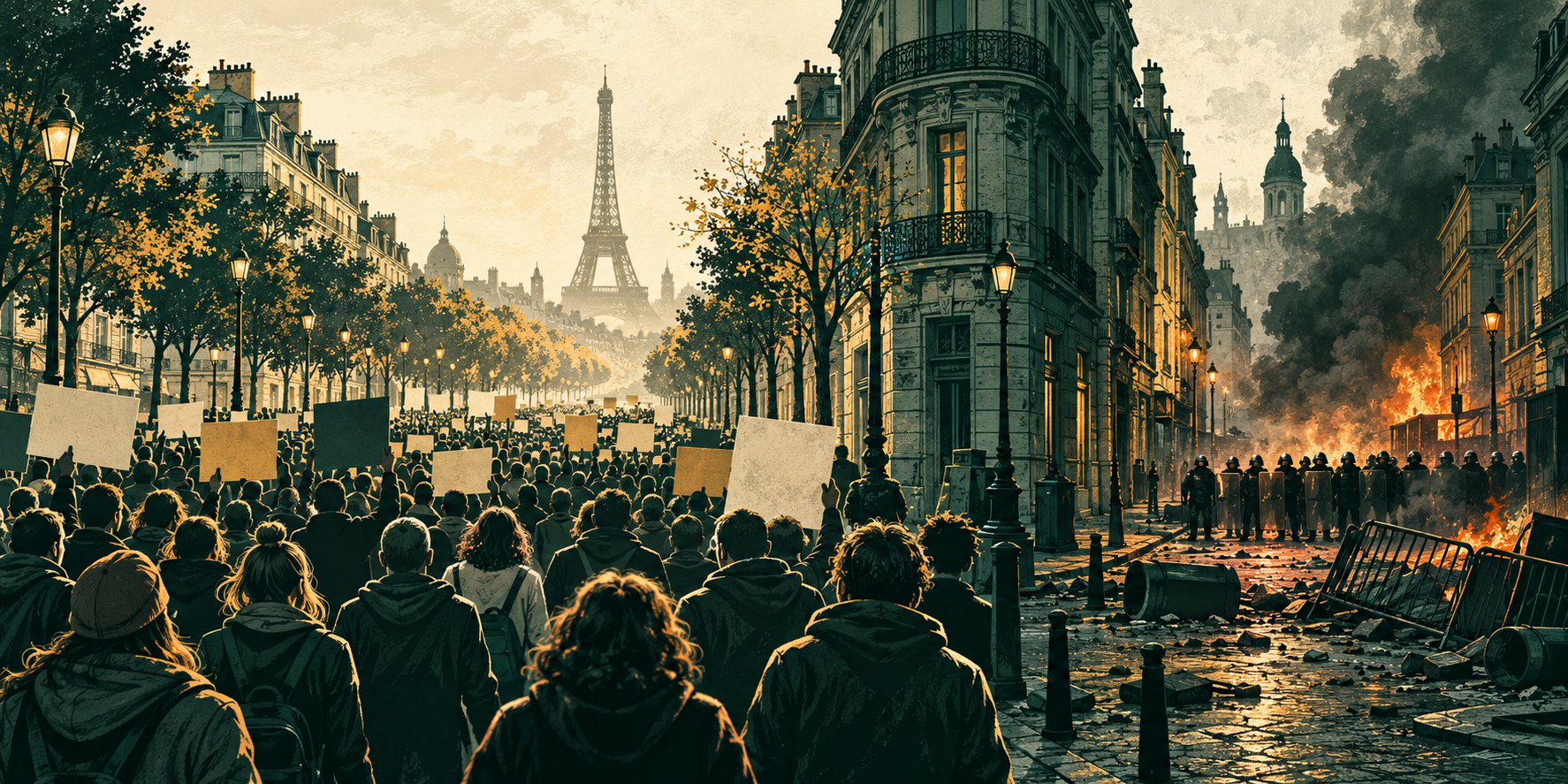
October presents a different question. AFP’s October 20 report, citing an unnamed security source, attributed a leading role in attacks on police and state symbols to ultraleft and radical-left currents. It distinguished those actors from a mixed population of opportunistic looters. The assessment did not attribute violence to La France Insoumise or the French Communist Party. Its classifications and allegations cannot substitute for identifying the perpetrators of each incident.[6]
A further bridge appears in Attac’s October 22 appeal for mobilizations on October 24 and November 5. Its signatories include Attac representatives, Solidaires co-delegates Julie Ferrua and Murielle Guibert, FSU secretary-general Caroline Chevé, Union syndicale lycéenne president Ryad Rani and Union étudiante secretary-general Eloïse Lefebvre Milon. Comparing the two statements shows continuity among French coalition actors from March to October, now alongside named student leaders. It does not show that the American co-signatory of the March call directed the October campaign or its violence.[15][1]
The practical consequence is that a protest roster and a criminal case file must be examined separately. Evidence of an organizer’s attendance, political sympathy or public appeal is insufficient to assign responsibility for arson, assault or looting. Conversely, evidence of an individual’s violence should not disappear inside an undifferentiated account of peaceful protest.
↑ Reading navigationThe investigation
Italy: student exchanges and the Siher investigation
ANSA reported on October 6 that students associated with Rete degli Studenti, OSA and Unione degli Universitari had traveled to Paris. Their account connected Italian education funding, school conditions and living costs with French grievances. This is evidence of solidarity and exchange before the later Milan disorder; the report does not establish instruction to commit violence.[5]
In a separate case, ANSA’s October 25 report describes prosecutors’ allegations that Youssef Siher used Movimento 17 ottobre social media to encourage crimes with a terrorist purpose and organized violence at demonstrations. His wife was also under investigation. Prosecutors alleged an effort to exploit unrest and mobilize later action.[7]
The same report said no direct link had been established to the October 17–18 Milan rioters and identified no state or organization behind the movement. A validation hearing remained pending in that report. These are allegations, not convictions; the original detention decree was not available for this edition.[7]
October 28 judicial follow-up: ANSA reports that Milan judge Tiziana Landoni ordered Siher’s release, rejected the grounds for detention and the prosecution’s interpretation of his messages as incitement to terrorist or organized violence, and instead described calls for peaceful protest and civil disobedience. This materially qualifies the October 25 allegations above. The original judicial order has not been independently examined here, and release at this stage is not a final acquittal.[16]
ISPI identifies Siher as a former Research Trainee. That past role does not implicate the institute. Neither the earlier allegations nor the subsequent release establishes an international command behind the unrest.[8]
↑ Reading navigationThe investigation
The European youth network and its political objectives
Socialist Students’ account of the October 17–18 Paris meeting reports 27 organizations from eleven countries. It describes a second in-person assembly after Cologne, delegates joining a Paris demonstration, and continued cooperation around the November 20 International Youth Strike. The attendance total remains a participant’s account rather than an independently audited roster.[2]
The coalition’s manifesto links opposition to militarization and conscription with education, welfare, climate and Palestinian causes. It calls for NATO’s dissolution, an end to fossil capitalism and radical systemic change. These are explicit political goals. Socialist Students also argues for a socialist international youth network, but its own proposal should not be attributed automatically to every participant.[3][2]
Swiss JUSO’s October 15 announcement independently establishes a national plan to join the November mobilization. Italy’s Rete della Conoscenza appears in the Paris participant account. Germany’s Cologne meeting supplies an earlier organizing milestone. Together these records show practical cross-border planning, while leaving the full roster, budget and distribution of authority unresolved.[4][2]
Greece provides a separate channel. The Communist Party of Greece’s October 19 account describes a KNE delegation marching in Paris on October 17 and an October 18 event with greetings from French communist representatives. This party report establishes its claimed solidarity activity. It does not by itself place KNE under the youth-strike coalition or connect the visit to violence.[12]
↑ Reading navigationThe investigation
Transatlantic advocacy and the Albanian connection
The Democracy Renewal Group’s July 17 declaration identifies the DRG–RAD International Solidarity Working Group as organizer. Endorsers include the Federal Workers Alliance for Democracy, #UnifyUSA, American Kleptocracy Clearinghouse, We Own It and named Indivisible groups. It supports Albanian opposition to development proposals linked to Jared Kushner and Ivanka Trump, calling for legal review and peaceful accountability.[9]
This is a direct bridge to organizations relevant to GIB’s When Hate Becomes Strategy investigation. It establishes a joint advocacy undertaking, not that every allegation about the development is proven, or that the endorsers paid for or directed unrest.
Indivisible Abroad describes a peaceful international network connecting overseas activists with U.S. partners, sharing resources and training information, and organizing cross-country activity. Progressive International supplies another overt channel: its October 16 briefing says it is supporting and connecting movements, including France’s student struggle and Albania’s Lëvizja Bashkë. These are distinct organizations and programs. Their overlapping interests are grounds for precise comparison, not for merging them into a single command structure.[10][11]
↑ Reading navigationThe investigation
Documented relationships and open questions
Each connection establishes only the relationship named. The diagram does not depict a common command structure or a proven funding chain to violence.
European youth coordination
Cologne assembly · June 14Paris assembly · October 17–18
Successive meetings, according to participant account[2]
Reported relationship
Paris assembly · October 17–18November 20–22 mobilization · planned
Organizing toward a common action date[2][3]
Reported relationship
Complete roster, decision-making authority and meeting expenses remain unresolved.
French–U.S. solidarity call
Indivisible ParisMarch 28 Bastille gathering · call
Co-signed March 23 statement[1]
Documented relationship
French union and civic signatoriesMarch 28 Bastille gathering · call
Co-signed March 23 statement[1]
Documented relationship
Co-signature does not establish participation in October violence.
U.S.–Albania advocacy
DRG–RAD working groupJuly 17 Albania solidarity declaration
Named organizer[9]
Documented relationship
FWAD and other endorsersJuly 17 Albania solidarity declaration
Named endorsements[9]
Documented relationship
No payment or violence instruction established by the declaration.
Historical national funding record
Open Society Action Fund IncIndivisible Project
$3 million · tax year 2023 · social-welfare activities[13]
Documented relationship
No onward European event payment established. Do not draw an arrow to Paris or riots.
Solid borders identify original statements or filed records; dashed borders identify participant accounts. These are relationship descriptions, not arrows of command. Question boxes have no causal connection.
↑ Reading navigationThe investigation
What the money trail shows, and where it stops
A concrete financial record exists: Open Society Action Fund Inc’s 2023 Form 990 reports a $3 million cash grant to Indivisible Project, EIN 81-4944067. Schedule I, entry 85, describes support for social-welfare activities. The return, signed November 14, 2024, identifies the fund as formerly known as Open Society Policy Center.[13]
The national grant and Indivisible Paris’s later French co-signature are separate facts. The reviewed records do not supply an onward transfer to Paris, an October assembly expense, or a payment for a violent act. The grant is a 2023 disclosure, not a 2026 French riot payment.[13][1]
The next useful financial evidence would identify a payer, recipient, amount, purpose and specific event: venue invoices, travel reimbursements, fiscal sponsorship agreements or restricted grants. A foundation’s overall resources, an organization’s public fundraising system or a donor’s political preferences cannot fill that transaction gap.
No reviewed evidence establishes Soros, Russia, China or another individual or state as the operational director of the protests examined here. That remains a conclusion about the evidence available, not a claim that all possible channels have been exhaustively investigated.
↑ Reading navigationThe investigation
Questions that could change the assessment
Who booked and paid for the Paris assembly, and which delegates had authority to commit their organizations? Original rosters, minutes and expenses would distinguish attendance from decision-making.
What specific conduct links a named organizer to a particular violent incident? Court records, authenticated instructions and complete statements are more probative than ideological labels or selected clips.
Will the Italian case establish contact with the original Milan perpetrators, or remain a case about later incitement? Subsequent judicial decisions and the defense’s response belong alongside the initial allegations.
Which announced November actions actually occur, and with what organizers and conduct? Planned events remain labeled as plans until evidence establishes their outcome.
This investigation will integrate material developments into the relevant country or relationship section, preserving event dates and earlier findings. A dated change record will explain substantive revisions without displacing the narrative or treating repeated claims as new evidence.
↑ Reading navigationA continuing record
Publication and material changes
Event dates remain attached to their evidence. New findings are integrated into the country or relationship they concern; the chronology retains event order. This record identifies substantive changes without moving updates above the introduction or navigation.
First public edition: documented organizing relationships, political objectives, funding limits and the reported Italian case.
Targeted Italy correction: adds ANSA’s October 28 report of Siher’s release and the judge’s rejection of the prosecution interpretation. Earlier organizing and funding evidence retains its original review date.
Sources checked October 26, 2026 UTC (October 25 Pacific). Publication does not imply a complete review of every European protest or a judicial finding against anyone named.
↑ Reading navigation